

Table of Contents
- Critical Medical Disclaimer & Introduction
- The Metabolic Mismatch: Cancer’s Fuel Addiction vs. Cellular Flexibility
- +The Three Pillars of Metabolic Therapy: A Multi-Pronged Attack
- Reviewing the Evidence: From compelling Preclinical Data to Promising Human Trials
- Major Considerations, Cautions, and Contraindications
- A Practical Starting Point: Resources and Next Steps
- Conclusion: A Partner in Care, Not a Panacea
1. Critical Medical Disclaimer & Introduction
The ketogenic diet is NOT a standalone cure for cancer. This article details a supportive metabolic therapy intended for use under strict medical supervision alongside standard oncological care (chemotherapy, radiation, immunotherapy). Never discontinue or refuse conventional treatment in favor of a diet. The decision to implement a ketogenic diet must be made in collaboration with your oncologist and a registered dietitian specializing in oncology and ketogenic therapy.
The landscape of cancer care is evolving beyond direct cytotoxic attacks to include strategies that alter the body’s internal environment. This approach, known as metabolic therapy, aims to create conditions that are hostile to cancer cell proliferation while strengthening healthy tissue. The ketogenic diet (KD) is at the forefront of this research. This article provides a detailed, scientific exploration of its proposed mechanisms and the current state of evidence.
2. The Metabolic Mismatch: Cancer’s Fuel Addiction vs. Cellular Flexibility
At the core of this therapy is a fundamental metabolic difference between most healthy cells and cancer cells.
- Healthy Cell Metabolism (The Hybrid Engine): Your body’s normal cells are metabolically flexible. They possess fully functional mitochondria—the powerhouses of the cell—and can efficiently produce energy (ATP) from either glucose or ketone bodies. When carbohydrates are restricted, they seamlessly switch to using fats and ketones, a state known as nutritional ketosis.
- Cancer Cell Metabolism (The Warburg Effect): In contrast, most cancer cells exhibit a profound metabolic flaw first observed by Otto Warburg. Even in the presence of ample oxygen, they rely primarily on a process called aerobic glycolysis—fermenting glucose into lactate for energy. This is an incredibly inefficient process, yielding only 2 ATP molecules per glucose molecule compared to the 36+ ATP produced by healthy mitochondrial metabolism.
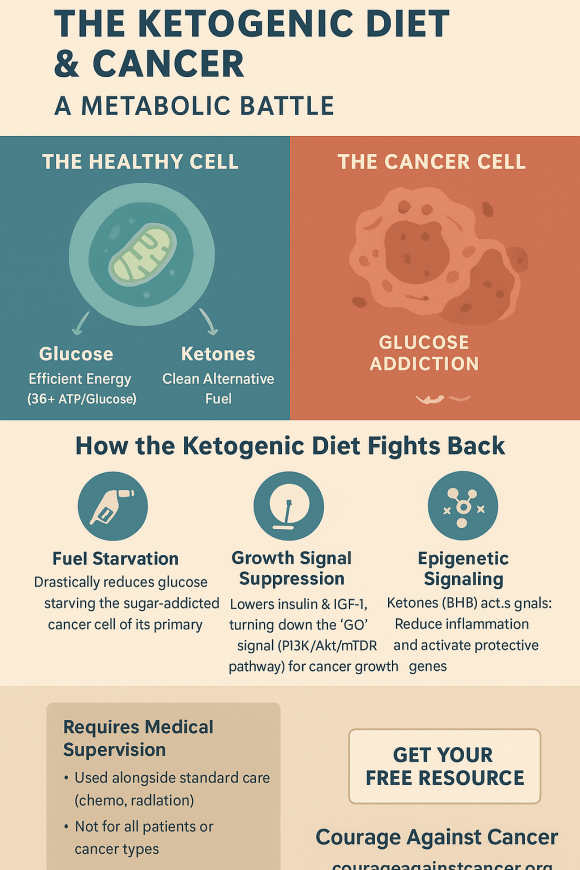
This creates a critical vulnerability: “metabolic rigidity.” Cancer cells are often so damaged they cannot efficiently use ketones and become utterly dependent on a constant stream of glucose. They are, in effect, “addicted to sugar.” This explains why tumors light up on PET scans, which use a radioactive glucose tracer to detect areas of high metabolic activity.
3. The Three Pillars of Metabolic Therapy: A Multi-Pronged Attack
The ketogenic diet, a high-fat, moderate-protein, very low-carbohydrate regimen, attacks this vulnerability through three distinct, synergistic mechanisms.
Pillar 1: Fuel Starvation – Exploiting the Warburg Effect
- The Mechanism: By reducing dietary carbohydrate intake to typically 20-50 grams per day, the KD drastically lowers blood glucose and glycogen stores. The body enters ketosis, and blood ketone levels rise.
- The Biological Impact: The cancer cell, reliant on massive glucose influx, finds its primary fuel supply severely diminished. This can induce an energy crisis within the tumor, potentially slowing growth and proliferation (anti-proliferative effect) and triggering programmed cell death (apoptosis). Meanwhile, healthy cells thrive on ketones.
Pillar 2: Hormonal Regulation – Suppressing Insulin and IGF-1
- The Mechanism: Carbohydrate intake is the primary stimulus for the secretion of insulin and Insulin-like Growth Factor-1 (IGF-1). The KD, by its very design, eliminates this stimulus, leading to dramatically lower basal levels of these hormones.
- The Biological Impact: Insulin and IGF-1 are not just metabolic hormones; they are potent mitogens (growth signals). They activate the PI3K/Akt/mTOR pathway, a central signaling cascade that tells cells to “grow, divide, and survive.” This pathway is notoriously hyperactive in many cancers. By lowering insulin and IGF-1, the KD helps deactivate this primary growth signal, potentially slowing tumor progression and making cancer cells more susceptible to apoptosis.
Pillar 3: Epigenetic Signaling – Ketone Bodies as Powerful Messengers
This is the most profound and recently elucidated pillar. Ketones, particularly beta-hydroxybutyrate (BHB), are not just fuel; they are potent signaling molecules.
- HDAC Inhibition: BHB acts as a histone deacetylase (HDAC) inhibitor. HDACs are enzymes that silence genes by winding DNA tightly around histones. By inhibiting HDACs, BHB promotes a more open DNA structure, activating protective genes. A key gene activated is FOXO3a, a transcription factor that upregulates cellular stress resistance, repair mechanisms, and antioxidant production (e.g., catalase, manganese superoxide dismutase).
- Reducing Inflammation: BHB directly inhibits the NLRP3 inflammasome, a complex inside immune cells that drives the production of powerful inflammatory cytokines like IL-1β. Chronic inflammation is a known promoter of tumor growth and metastasis.
- Differential Oxidative Stress Management: Ketone metabolism produces fewer reactive oxygen species (ROS) than glucose metabolism. Furthermore, by boosting antioxidant defenses via FOXO3a, BHB may protect healthy cells from damage caused by chemotherapy and radiation. Evidence suggests cancer cells, already under high oxidative stress, may not receive this same protective benefit, making them more vulnerable.
4. Reviewing the Evidence: From Compelling Preclinical Data to Promising Human Trials
- Preclinical Studies (In Vitro & Animal Models): The evidence from laboratory settings is overwhelmingly strong and consistent. Studies across a wide array of cancer types (glioblastoma, colorectal, prostate, lung, pancreatic) demonstrate that the KD can reduce tumor growth, enhance survival, and significantly increase the efficacy of standard therapies like chemotherapy and radiation.
- Human Clinical Data: The human data is promising but preliminary.
- Safety & Feasibility: Multiple clinical trials have established that medically supervised ketogenic diets are safe and feasible for many cancer patients, with manageable side effects (e.g., constipation, transient fatigue).
- Efficacy Signals: Early-phase trials, case series, and numerous anecdotal reports show encouraging results, including:
- Disease stabilization and, in some cases, partial regression.
- Improved quality of life, cognitive function, and physical energy.
- Differential Stress Resistance: Potential for reduced toxicity and side effects from conventional treatments, as healthy cells may become more resilient while cancer cells are sensitized.
- The Caveat: Large-scale, randomized controlled trials (RCTs)—the gold standard for evidence—are still ongoing. Larger studies are needed to definitively prove efficacy for specific cancer types.
5. Major Considerations, Cautions, and Contraindications
The KD is a powerful intervention and is not appropriate for all patients. It is contraindicated and can be dangerous in conditions such as:
- Pancreatitis
- Liver failure
- Certain rare metabolic disorders (e.g., fatty acid oxidation disorders, pyruvate carboxylase deficiency)
- Severe cachexia (muscle wasting) may also be a contraindication, as careful monitoring is needed to prevent further muscle loss.
Medical supervision is non-negotiable. An oncology dietitian is essential to ensure nutritional adequacy, manage electrolyte balance, and tailor the diet to the individual’s needs and treatment schedule.
6. A Practical Starting Point: Resources and Next Steps
- Consult Your Oncology Team: This is the first and most critical step. Share this information and express your interest.
- Seek a Qualified Dietitian: Insist on a referral to a registered dietitian (RD) with specific expertise in oncology nutrition and ketogenic metabolic therapy.
- Educate Yourself with Reliable Resources: Understanding the theory is key to successful implementation.
👉 Empower Your Journey with Knowledge and Recipes
To help you understand what a well-formulated ketogenic diet looks like in practice, we offer a free resource to get you started. Download our complimentary cookbook, ‘Keto for Cancer: Recipes to Nourish and Thrive’, for practical, nutritious meal ideas designed to support your body.

7. Conclusion: A Partner in Care, Not a Panacea
The ketogenic diet represents a paradigm shift in supportive cancer care, moving from a solely targeted approach to one that also modifies the host environment. By exploiting the metabolic Achilles’ heel of cancer through fuel deprivation, hormonal regulation, and epigenetic signaling, it offers a compelling, biologically-plausible adjunct to standard care. While more robust human data is needed, the current evidence justifies its serious consideration under professional guidance. It is a tool for empowerment, offering patients and caregivers a proactive role in building a comprehensive and metabolic-informed treatment plan.
Help Coco and Jake (the Koala’s) Keep up the Good Fight!

Your support empowers this vital mission. The comprehensive research and patient resources we provide, like the free cookbook you discovered today, are made possible by the generosity of our community. This isn’t just about sharing information; it’s about fueling a future where metabolic therapy is a fully understood and accessible component of integrative cancer care. If this deep dive into the science has given you knowledge, hope, or a new sense of empowerment, please consider paying that forward. Your tax-deductible donation today will directly fund critical research, expand our educational resources, and help us guide more patients and families toward empowered choices. Every contribution, no matter the size, helps us nourish this fight.
Make a one-time donation
Make a monthly donation
Make a yearly donation
Choose an amount
Or enter a custom amount
Your contribution is appreciated.
Your contribution is appreciated.
Your contribution is appreciated.
DonateDonate monthlyDonate yearlyDiscover more from Courage Against Cancer
Subscribe to get the latest posts sent to your email.
 Courage Against Cancer