

Table of Contents
- Introduction
- Glossary
- What Is Fenbendazole and Why Is It Being Used for Cancer?
- The Science Behind Fenbendazole’s Anti-Cancer Mechanisms
- The Joe Tippens Story: How Fenbendazole Entered the Cancer Conversation
- Fenbendazole Cancer Protocol: Exact Dosage and Cycling Schedule
- Companion Supplements in the Full Fenbendazole Protocol
- What Cancer Types Has Fenbendazole Been Studied For?
- Preclinical and Clinical Research on Fenbendazole and Cancer
- Expected Timeline: When Do People Report Seeing Results?
- Safety Profile, Side Effects, and Drug Interactions of Fenbendazole
- How to Talk to Your Oncologist About Fenbendazole as a Complementary Approach
- FAQ
- Conclusion
- Medical Disclaimer
- Sources
Introduction
Courage Against Cancer (CAC) exists to equip cancer patients, survivors, and caregivers with evidence-based answers to the most pressing questions surrounding cancer and complementary approaches — including information about emerging topics like fenbendazole, a veterinary drug that some people have explored as an unproven complementary approach. Note: Fenbendazole is not approved for cancer treatment and lacks clinical evidence of effectiveness in humans. Fenbendazole is a decades-old veterinary antiparasitic drug that has drawn growing interest as a potential complementary cancer strategy, primarily because some laboratory studies in cell cultures and animal models have suggested it may affect certain cellular processes, though these preclinical findings have not been validated in human clinical trials. Remarkably, interest in this compound surged globally after a single patient’s widely shared testimonial, underscoring how urgently people living with cancer seek options beyond conventional treatment alone. This article covers everything the research currently tells us: the proposed mechanisms of action, the protocol as it is most commonly practiced, the rationale for each companion supplement, safety considerations, and how to approach a productive, informed conversation with your oncologist. Explore CAC’s full Wellness Blueprint to see how complementary strategies fit into a comprehensive cancer-wellness plan.
Glossary
Anthelmintic — A class of drugs designed to expel or destroy parasitic worms (helminths) in the body. Fenbendazole belongs to this class and was originally developed exclusively for veterinary use.
Microtubule Polymerization — The process by which tubulin proteins assemble into microtubules — structural components cells need to divide. Drugs that disrupt microtubule polymerization can halt cell division.
Drug Repurposing — The scientific and clinical process of investigating whether an existing, approved drug developed for one condition may be effective against a different disease, often at lower development cost and with an already-known safety profile.
Glucose Uptake Inhibition — The blocking or reduction of a cell’s ability to absorb glucose (sugar) for energy. Cancer cells rely heavily on glucose metabolism, making this mechanism particularly relevant to oncology research.
Apoptosis — The orderly, programmed process of cell death. Healthy cells undergo apoptosis when they are damaged or no longer needed; many cancer cells develop the ability to evade this process.
Bioavailability — The proportion of a substance that enters circulation when introduced into the body and is thus able to exert an active effect. Fenbendazole has relatively low oral bioavailability in humans, which is why fat-containing meals are often recommended alongside it.
What Is Fenbendazole and Why Is It Being Used for Cancer?
Fenbendazole is a broad-spectrum benzimidazole anthelmintic compound that has been used safely in veterinary medicine for decades to treat parasitic worm infections in dogs, cats, horses, and other animals. It is sold under brand names such as Panacur and Safe-Guard. It is not approved by the FDA or any regulatory agency worldwide for cancer treatment or for any human use. Using veterinary formulations in humans is considered off-label and experimental.
Interest in fenbendazole as a cancer-related complementary approach grew from a convergence of two forces: an extraordinary personal story that went viral online, and a body of preclinical laboratory research suggesting that benzimidazole-class drugs may interfere with processes that cancer cells depend upon.
The concept driving this interest falls under drug repurposing. However, it’s important to understand that most drug repurposing candidates fail in clinical trials, and theoretical promise in laboratory settings rarely translates to actual human benefit. Because fenbendazole’s safety profile in mammals is well characterized and its cost is very low, researchers and patients alike have found it worth investigating.
Key reasons fenbendazole has attracted cancer-research attention:
- Structural similarity to known cancer drugs like mebendazole and albendazole. Note: Structural similarity does not imply equivalent clinical effects, and even mebendazole and albendazole are not approved cancer treatments.
- Multiple hypothesized mechanisms observed in laboratory settings, none of which have been confirmed to produce clinical benefit in human cancer patients
- Low cost and wide availability compared with experimental oncology drugs
- Decades of safety data from veterinary and limited human antiparasitic use
CAC’s Wellness Blueprint helps patients contextualize emerging complementary strategies like this one within a broader wellness framework.
The Science Behind Fenbendazole’s Anti-Cancer Mechanisms
Laboratory studies and preclinical research have proposed several distinct mechanisms through which fenbendazole may affect cancer cells. Understanding these mechanisms is essential for having an informed conversation with your care team.
1. Microtubule Disruption
Fenbendazole binds to a protein called beta-tubulin, interfering with microtubule polymerization. Microtubules are the scaffolding that cells use to pull chromosomes apart during division. When this process is disrupted, cancer cells cannot divide correctly, which may trigger cell death. This is the same general mechanism used by well-established chemotherapy drugs in the taxane and vinca alkaloid families.
2. Glucose Uptake Inhibition
Cancer cells consume glucose at dramatically higher rates than healthy cells — a phenomenon known as the Warburg effect. Laboratory studies have found that fenbendazole may suppress certain glucose transporter proteins and reduce the activity of enzymes critical to glycolysis (the process cells use to convert glucose into energy), potentially starving cancer cells of fuel.
3. Apoptosis Induction
Cell studies have observed that fenbendazole may activate the p53 tumor suppressor protein, which is sometimes called the “guardian of the genome.” When p53 is activated, it can trigger programmed cell death in abnormal or damaged cells — the process known as apoptosis.
4. Autophagy Modulation
Some preclinical research suggests fenbendazole may influence autophagy — the cellular “self-cleaning” process — in ways that could make cancer cells more vulnerable.
These mechanisms, studied primarily in laboratory and animal settings, provide the biological rationale for ongoing interest in fenbendazole as a subject of cancer research.
One of our preferred affiliate vendors: BP Life

The Joe Tippens Story: A Single Anecdotal Report (Note: Individual testimonials cannot establish treatment effectiveness, and this patient was also receiving conventional treatment)
No honest discussion of the fenbendazole cancer protocol is complete without acknowledging the story that ignited global public interest. Joe Tippens was an American man diagnosed with small-cell lung cancer that had spread extensively throughout his body. Given a terminal prognosis, he enrolled in a clinical immunotherapy trial — and simultaneously, on the advice of a veterinarian he knew personally, began taking fenbendazole along with a specific set of supplements.
His subsequent scans reportedly showed a dramatic resolution of cancer throughout his body. Tippens shared his story publicly through a blog that has since been read by millions of people worldwide. His protocol — which combined fenbendazole with vitamin E succinate, curcumin, and CBD oil — became widely known as the “Joe Tippens Protocol.”
Important caveats every patient should understand:
- Tippens was simultaneously receiving immunotherapy in a clinical trial, making it impossible to attribute his outcome to fenbendazole alone
- His case is a single anecdotal report, not a controlled clinical study
- Anecdotal reports, however compelling, cannot establish cause and effect
- The cancer and medical research communities continue to investigate fenbendazole, but no peer-reviewed clinical trial has yet confirmed his results in a controlled human population
Tippens’s story is a powerful example of hope — and of why rigorous research into drug repurposing matters. CAC honors patient stories while always grounding them in honest scientific context. Browse our Healing Store for evidence-informed wellness support products.
Another one of our preferred affiliate vendors: FenBen Lab

Fenbendazole Cancer Protocol: Exact Dosage and Cycling Schedule
Anecdotal Fenbendazole Regimens: Unvalidated Dosages Circulating Online (Not Clinically Tested)
The fenbendazole cancer protocol dosage and timeline most widely referenced in patient communities is derived directly from Joe Tippens’s publicly shared account and has been broadly discussed in online patient forums and some research commentary. This is not an FDA-approved protocol. The following is educational information about what people report using — not a prescription or recommendation.

Download full version > Fenbendazole Dosage Guide
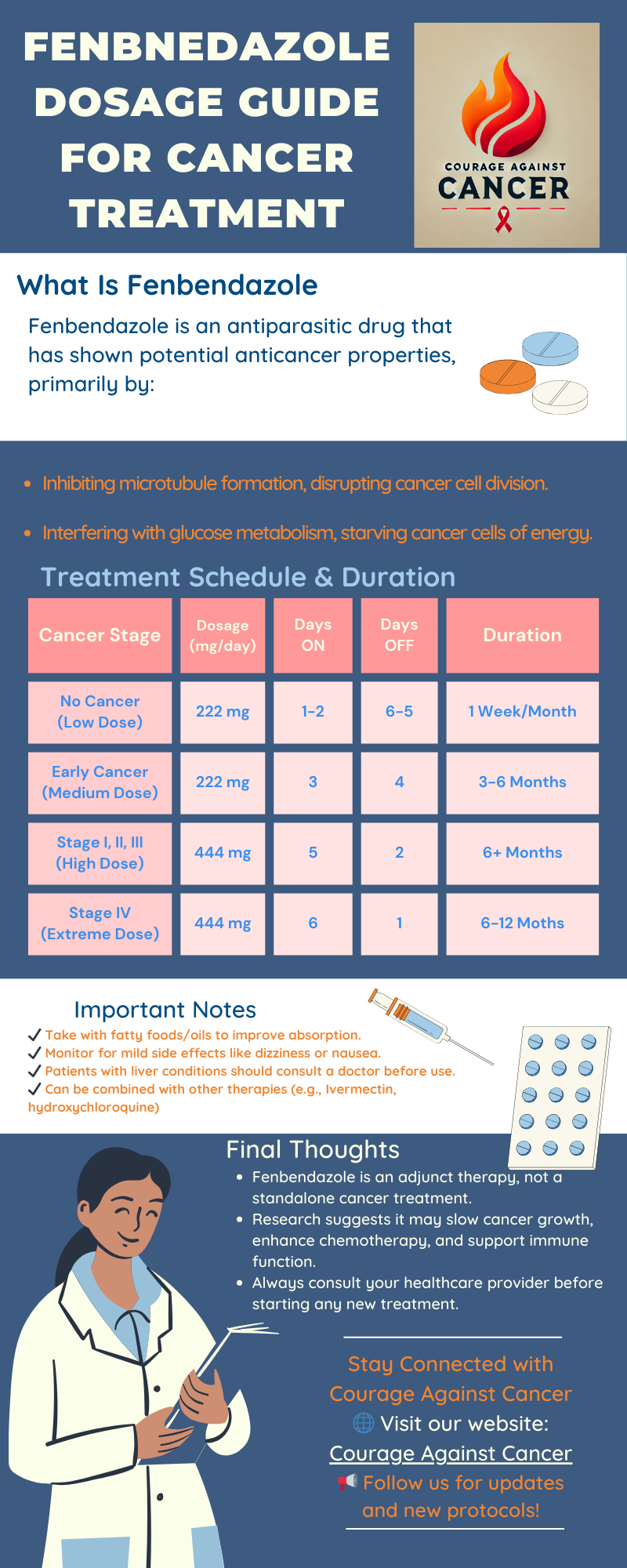
Commonly Reported Dosage:
- 222 mg of fenbendazole taken orally, three days per week
- The remaining four days of each week are rest days (no fenbendazole)
This 3-days-on / 4-days-off cycling schedule is the most frequently described pattern in patient communities. Some individuals report using slightly different schedules (such as 5 days on / 2 days off), but the 3/4 cycle is the most widely cited.
Why a Cycling Schedule?
The rationale offered in patient discussions typically centers on two ideas:
- Allowing the body periodic rest to manage any potential metabolic stress
- Mimicking scheduling approaches used in some pharmaceutical protocols to prevent tolerance
Formulation Considerations:
Fenbendazole is most commonly available as:
- Powder (often sold in 1-gram sachets for dogs)
- Granules or paste (veterinary formulation)
- Capsules (some human-use formulations marketed as supplements in certain markets)
Because fenbendazole has low oral bioavailability, most protocol descriptions recommend taking it with a fat-containing meal (such as one that includes olive oil, avocado, or another healthy fat source) to improve absorption.
Patients must discuss any supplement or off-label compound with their oncologist before starting.
Companion Supplements in the Full Fenbendazole Protocol
The Joe Tippens Protocol, as it became known, was never fenbendazole alone. Tippens described taking a specific set of supplements alongside fenbendazole, and proponents suggest these companions may work synergistically. Here is the educational breakdown of each:
1. Vitamin E Succinate (400–800 IU, taken on the same days as fenbendazole)
Vitamin E succinate is a specific form of vitamin E — distinct from more common forms like alpha-tocopherol. Laboratory studies have found that this particular form may have pro-apoptotic effects on cancer cells, meaning it may help trigger programmed cancer cell death. It is also believed to support fenbendazole’s bioavailability by providing a fat-soluble carrier environment.
2. Curcumin (typically 600 mg daily, taken every day)
Curcumin, the active compound in turmeric, has been extensively studied in laboratory settings for its anti-inflammatory and potential anti-cancer properties. Cell studies have observed it may inhibit pathways that help cancer cells survive and spread. It is commonly taken daily throughout the protocol.
3. CBD Oil (25 mg daily, taken every day)
Cannabidiol (CBD) was included in Tippens’s original account. Some preclinical research has explored whether cannabinoids may have anti-tumor properties. The evidence base here is early-stage, but its inclusion in the protocol as an anti-inflammatory support agent is the most common rationale cited.
Why these supplements together?
The combined rationale is that each agent may target a different vulnerability in cancer cell biology — creating what proponents describe as a multi-pronged complementary approach. None of these supplements should replace standard oncology care. Explore supportive wellness downloads (dosage guidelines, specific protocols, ketogenic cookbook – all FREE) on the CAC Resources and products like Fenbendazole, microbiome testing, genetic testing and berberine in our Healing Store.
Examples: Advanced Supplement Guideline | Courageous Healing Cancer Protocol Master Table
What Cancer Types Has Fenbendazole Been Studied For?
Laboratory and preclinical research has examined fenbendazole’s potential effects across a range of cancer cell types. It is important to note that nearly all of this research has been conducted in cell cultures or animal models — not in large-scale human clinical trials.
Cancer types that have appeared in preclinical and laboratory research discussions include:
- Lung cancer — Given the Tippens story, this has received considerable informal attention; some cell studies have explored effects on lung cancer cell lines
- Colorectal cancer — Some laboratory studies have found benzimidazole-class compounds to affect colorectal cancer cells in preclinical settings
- Prostate cancer — Cell studies have examined potential apoptotic effects
- Breast cancer — Preclinical research has explored glucose inhibition effects in breast cancer cell models
- Lymphoma and leukemia — Some cell-line research has investigated benzimidazole effects in blood cancers
- Glioblastoma — A limited body of laboratory research has explored microtubule-disrupting effects in brain tumor cells
- Pancreatic cancer — Early-stage research has noted potential effects on pancreatic cancer cell survival
What this does NOT mean:
Laboratory findings in cell cultures do not automatically translate into effective treatments in humans. Many compounds that show promise in preclinical settings do not demonstrate the same effects in human clinical trials. Patients should understand this distinction clearly before drawing conclusions.
Preclinical and Clinical Research on Fenbendazole and Cancer
This article summarizes the limited preclinical research that exists and describes unvalidated protocols that circulate online. No clinical trials have established fenbendazole’s effectiveness against cancer in humans.
The research landscape on fenbendazole and cancer is real, growing, and genuinely promising — while remaining predominantly preclinical. Here is an honest, evidence-based summary.
What the research has found:
- Laboratory studies have found that fenbendazole can inhibit the growth and survival of various cancer cell lines by disrupting tubulin binding, interfering with glucose metabolism, and activating apoptotic pathways
- Researchers have observed in animal models that fenbendazole administration was associated with reduced tumor growth
- Some preclinical research suggests that fenbendazole may enhance the effects of certain other compounds, including some used in conventional oncology
- A peer-reviewed case report published in a scientific journal documented the Tippens-like use of fenbendazole in a cancer patient, contributing to the formal literature, though a single case report cannot establish efficacy
What the research has NOT yet established:
- No large-scale, randomized, controlled human clinical trials have confirmed fenbendazole’s efficacy as a cancer treatment
- Optimal human dosing has not been established through clinical research
- Long-term safety at higher or prolonged doses in humans is not fully characterized
The bottom line: The preclinical evidence is scientifically interesting and justifies continued formal research. It does not yet constitute proof of clinical efficacy in humans. CAC’s mission is to give you evidence-based answers to hard questions — including honest ones. Visit our Wellness Blueprint for a full picture of complementary wellness approaches.
Expected Timeline: When Do People Report Seeing Results?
One of the most common questions surrounding the fenbendazole cancer protocol dosage and timeline is simply: how long before anything happens? This question deserves a careful, honest answer.
Anecdotal Reports: What Some Individuals Have Claimed (Note: These reports are unverified and do not constitute evidence of effectiveness)
- Many individuals who report positive experiences describe maintaining the protocol for a minimum of 3 months before drawing conclusions
- Some accounts describe subjective improvements (energy, appetite, wellbeing) within the first few weeks
- Objective changes — meaning changes visible on imaging or measurable in tumor markers — are typically not reported before 2 to 3 months of consistent protocol adherence
- Joe Tippens himself described his dramatic imaging changes occurring over several months while simultaneously receiving immunotherapy
What science can and cannot tell us about timeline:
- Laboratory studies cannot reliably predict human response timelines
- Individual factors including cancer type, stage, overall health, concurrent treatments, and genetics all influence any observed response
- No controlled clinical data currently exists from which to draw population-level timeline conclusions
Practical considerations for patients:
- Any timeline evaluation should be conducted alongside — and guided by — your oncology team
- Tumor marker tests and imaging ordered by your doctor are the appropriate tools for evaluating change
- Discontinuing standard treatment to pursue fenbendazole alone is not supported by any current evidence
Setting evidence-grounded expectations is an act of self-care. CAC is here to help you navigate that process. Browse supportive resources at our Healing Store.
Safety Profile, Side Effects, and Drug Interactions of Fenbendazole
Understanding the safety landscape of fenbendazole is essential for any patient considering it as a complementary approach. Here is what is currently known, grounded in honest scientific context.
General Safety Background:
While fenbendazole has been used safely in animals for parasitic infections, its safety profile for long-term use in humans at cancer-protocol doses has not been established through clinical trials. Self-administration carries unknown risks. Related benzimidazole compounds (such as mebendazole and albendazole) have been used in humans to treat parasitic infections, providing some comparative safety data.
Reported Side Effects in Human Use:
- Gastrointestinal symptoms — nausea, abdominal discomfort, and loose stools are the most commonly reported side effects
- Liver enzyme elevation — some reports in patient communities have noted transient liver enzyme changes; liver function monitoring is commonly recommended by clinicians who engage with patients using this protocol
- Allergic reactions — rare but possible, as with any compound
Potential Drug Interactions to Discuss With Your Doctor:
- Fenbendazole may interact with certain chemotherapy agents, particularly those that also affect microtubule function (such as taxanes)
- Its fat-soluble nature means it may influence the absorption of other fat-soluble compounds
- Curcumin and CBD, the companion supplements, each have their own interaction profiles with oncology drugs
Who Should Use Extra Caution:
- Patients with pre-existing liver conditions
- Patients on active chemotherapy regimens
- Patients with known drug sensitivities
The key message: Fenbendazole appears to have a relatively manageable side-effect profile based on limited human data, but “relatively safe in animals” does not mean “proven safe at any dose in all humans.” Always involve your medical team.
How to Talk to Your Oncologist About Fenbendazole as a Complementary Approach
Many patients feel apprehensive about bringing up topics like fenbendazole with their oncologist, fearing dismissal or conflict. CAC wants you to know: you have every right to ask questions, and a good oncologist will engage with you thoughtfully.
Before the conversation:
- Write down your specific questions
- Bring any information you’ve read — including articles like this one — so your doctor can review your sources
- Be clear about your goal: information and safety, not bypassing medical care
What to ask your oncologist:
- “I’ve been reading about fenbendazole as a complementary approach. Are you familiar with the preclinical research?”
- “Are there any interactions I should know about given my current treatment plan?”
- “Would you be willing to monitor my liver enzymes if I choose to explore this?”
- “Are there any clinical trials studying benzimidazole compounds that I might qualify for?”
What a productive conversation looks like:
- Your doctor may not endorse fenbendazole — that is understandable given the current evidence level
- A collaborative oncologist will discuss risks, interaction concerns, and monitoring options even if they are skeptical
- The goal is informed shared decision-making, not unilateral action
What CAC recommends:
- Never discontinue standard treatment without medical guidance
- Use complementary approaches alongside, not instead of, your oncology plan
- Document what you take, when you take it, and any changes you notice
CAC’s Wellness Blueprint is a practical guide designed to help you build exactly this kind of thoughtful, coordinated complementary wellness strategy.
FAQ
What is the standard fenbendazole dosage used in the cancer protocol?
The most widely referenced dosage in patient communities is 222 mg of fenbendazole taken orally on three days per week. This figure derives from Joe Tippens’s publicly shared account and is commonly cited in online forums. This dosage has not been validated or approved in human clinical trials, and patients should discuss any dosage with their oncologist before starting.
How do you cycle fenbendazole for cancer — how many days on and off?
The most commonly described fenbendazole cycling schedule is three consecutive days on followed by four days off, repeating weekly. Some individuals in patient communities report variations such as five days on and two days off. No clinical data currently establishes which cycling schedule — if any — is optimal for human use.
Can fenbendazole be taken alongside chemotherapy or radiation?
This is a critical safety question that must be answered by your oncology team. Some chemotherapy drugs — particularly taxanes — work through mechanisms that overlap with fenbendazole’s proposed microtubule effects, raising questions about potential interactions. Your oncologist needs to know about every supplement or compound you take during active treatment. Do not make this decision without medical guidance.
What form of fenbendazole do people use — powder, capsule, or liquid?
The most commonly used form described in patient communities is the powder formulation, typically sold in 1-gram sachets marketed for dogs (such as Panacur granules). Some markets offer fenbendazole in capsule form as a supplement. Because bioavailability is low, most protocol descriptions recommend taking it with a fat-containing meal regardless of formulation to improve absorption.
Why is vitamin E succinate included in the fenbendazole cancer protocol?
Vitamin E succinate — a specific esterified form of vitamin E — is believed by protocol proponents to serve two purposes: first, as a fat-soluble agent that may improve fenbendazole’s bioavailability; and second, because laboratory studies have found this particular form of vitamin E may promote apoptosis in certain cancer cells. It is specifically vitamin E succinate, not generic vitamin E, that Tippens described using.
How does fenbendazole kill cancer cells differently than healthy cells?
Fenbendazole is proposed to exploit biological characteristics that are more pronounced in cancer cells than in healthy ones — particularly cancer cells’ heavy dependence on glucose metabolism and their rapid, uncontrolled division requiring microtubule activity. Healthy cells also use microtubules and glucose, which is why understanding selectivity matters. Preclinical studies have suggested a degree of preferential effect on cancer cells, but research is still ongoing on precisely how selective this effect is in human biology.
Is there peer-reviewed research supporting fenbendazole as a cancer treatment?
Yes — there is peer-reviewed preclinical research (in cell cultures and animal models) published in scientific journals that describes anti-cancer effects of fenbendazole. There is also at least one published case report in the peer-reviewed literature. However, there are currently no large-scale, randomized controlled clinical trials in humans that establish fenbendazole as a proven cancer treatment. The evidence is promising but still preliminary at the clinical level.
How long should someone stay on the fenbendazole protocol before evaluating results?
Patient accounts most commonly describe maintaining the protocol for a minimum of three months before making judgments about effectiveness. Any evaluation of results should rely on objective measures — imaging and tumor markers ordered by your oncology team — rather than subjective feelings alone. No evidence-based clinical guideline exists for this timeline; it is derived from anecdotal community experience.
Are there any cancers for which fenbendazole appears most effective based on research?
Preclinical research has examined fenbendazole across multiple cancer types including lung, colorectal, prostate, and blood cancers. No current research — at the clinical level — establishes that fenbendazole is more effective for one cancer type than another in humans. The cancer types most discussed in research literature reflect where laboratory curiosity has been focused, not proven clinical outcomes in human patients.
Where can patients obtain fenbendazole and is it legal to use in humans?
Fenbendazole is legally sold without a prescription as a veterinary product in the United States and many other countries. It is not illegal to purchase. However, it is not FDA-approved for human use, meaning it is used “off-label” in the human context. Some countries have pharmaceutical-grade human formulations. Patients should source products carefully, as quality control varies widely in veterinary and supplement markets. Always inform your doctor of any product you are using.
Conclusion
The fenbendazole cancer protocol represents one of the most discussed examples of drug repurposing in patient communities worldwide — and for reasons that are both scientifically understandable and deeply human. Laboratory research has found genuine, mechanistically plausible reasons to continue investigating this compound. At the same time, honest science requires acknowledging that preclinical promise has not yet been confirmed in large-scale human clinical trials.
At Courage Against Cancer, we believe patients deserve both truth and hope — not one at the expense of the other. If you are exploring fenbendazole as a complementary approach, bring this article to your oncologist, ask the right questions, and never navigate this journey alone. CAC’s Wellness Blueprint is designed to help you build a comprehensive, coordinated approach to cancer wellness — one that honors the full picture of who you are, not just your diagnosis. Explore supportive resources at our Healing Store and know that you are not alone in this fight. Courage is not the absence of fear — it is moving forward, informed and supported, anyway.
Medical Disclaimer
This content is for educational purposes only and does not constitute medical advice. Always consult a qualified healthcare provider before making health decisions. Courage Against Cancer does not diagnose, treat, cure, or prevent any disease.
Sources
1. Dogra, N., et al. “Fenbendazole acts as a moderate microtubule destabilizing agent and causes cancer cell death by modulating multiple cellular pathways.” Scientific Reports, Nature Publishing Group. Available via PubMed: https://pubmed.ncbi.nlm.nih.gov/
2. National Cancer Institute. “Drug Repurposing.” National Cancer Institute, U.S. Department of Health and Human Services. https://www.cancer.gov/research/drug-repurposing
3. Choi, Y.H. “Fenbendazole exerts anti-proliferative effects against lung adenocarcinoma cells via the p53 pathway.” Cancer Medicine, Wiley. Available via PubMed: https://pubmed.ncbi.nlm.nih.gov/